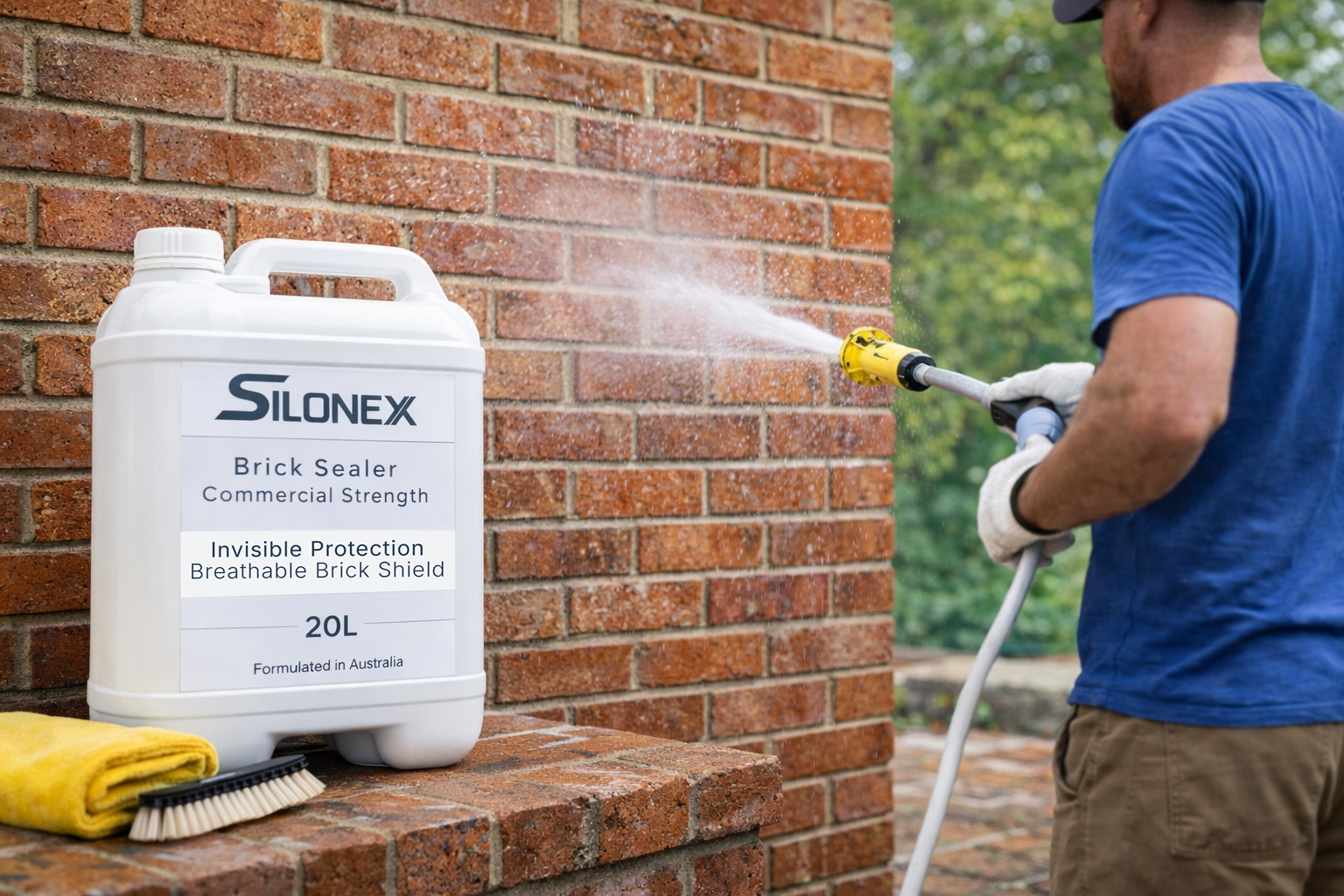
Penetrating silane sealer for face brickwork. 40% active silane in an aromatic-free carrier.
Reacts inside the pore. No film, no gloss, no colour change.
Solvent carried, low odour. Not a Dangerous Good under the ADG Code. Combustible liquid, keep away from heat and ignition sources.
Coverage
Dense face brick: 6 to 8 m² per litre
Standard clay brick: 4 to 6 m² per litre
Porous, aged or weathered brick: 2 to 4 m² per litre
Brick drinks more than concrete. Coverage varies between brick types and between batches. Measure your own rate on a test area before ordering for the full job.
Intended Use
Reducing rainwater absorption into face brickwork
Reducing water driven staining and dirt pickup
Keeping walls drier between rain, so moss, algae and lichen have less to establish in
Maintaining vapour permeability of the wall
Suitable for face brickwork where the natural appearance must be kept.
Suitable Substrates
Face brickwork
Chimneys and parapets
Garden, boundary and retaining wall faces above ground
Rendered and bagged brickwork
Concrete blockwork
Sandstone
Not suitable for:
Brickwork with rising damp, salt staining, white powdery efflorescence, or a history of any of these. Read the warning below.
Limestone, travertine and marble. These are calcareous and contain no silica for the silane to bond to. Use a modified siloxane made for calcareous stone.
Painted or previously sealed brickwork. Strip it first.
Below ground or tanking work. This is not a waterproofing membrane and does not hold back hydrostatic pressure.
Read this before you buy it
Do not seal a wall that has a moisture problem behind it.
Sealing the face does not stop water arriving from inside the wall or up from the ground. It stops it leaving. Salt carried by that moisture then crystallises just under the treated face instead of on it, and the face of the brick blows off. The wall looks worse than before you started, and it is not reversible.
The rule is simple. Seal only where the face you are treating is the only way water gets in.
If the wall has rising damp, fix the damp proof course first. If the wall has salt in it, deal with the salt first. If you are not sure, do not seal it.
Functional Characteristics
Penetrating, non film forming treatment
Chemically bonds to the silica in the brick and mortar
Repels liquid water and reduces capillary uptake
Allows water vapour to escape
Keeps the natural colour and texture of the brickwork
No surface film to peel, cloud, blister or lift
What it does not do
No colour change and no gloss. The brickwork looks the same afterwards.
Does not fix rising damp. That needs a damp proof course.
Does not stop water tracking through cracked or perished mortar joints. Repoint first, let the mortar cure, then seal.
Does not stop graffiti.
No oil or grease resistance. Silane repels water only.
Does not bridge cracks. Fill cracks first.
Application
Low pressure sprayer, brush or roller.
Repair first. Repoint failed joints, fill cracks, and allow new mortar a minimum 28 days before sealing.
Clean thoroughly. Remove dirt, moss, lichen and any surface salt. Allow the wall to dry completely.
Water bead test. Splash water on the brick. If it soaks in, the wall is ready. If it beads, there is a coating present and it has to come off first.
Mask glass, glazed tile, powder coated aluminium, painted surfaces, timber and anything you do not want treated. Silane bonds permanently to glass. Wet down plants before and after.
Work bottom to top. Flood the surface so material runs 150 to 200 mm below the wet line, and keep the edge wet as you move across.
Apply until the surface stops taking it in. Porous or weathered brick usually needs a second pass, applied wet on wet within 15 minutes.
Conditions
Substrate dry. Minimum 28 days cure on new brickwork and new mortar.
Apply between 5°C and 30°C. Not in direct sun on a hot wall.
No rain forecast for 6 hours.
Water repellent within 4 to 6 hours.
Full cure 5 to 7 days. Clay brick cures slower than the mortar joints because it is close to pH neutral and does not catalyse the reaction the way cement does. Do not judge the result until day 7.
Coverage and cure times are guidance. Performance depends on substrate condition and correct application.